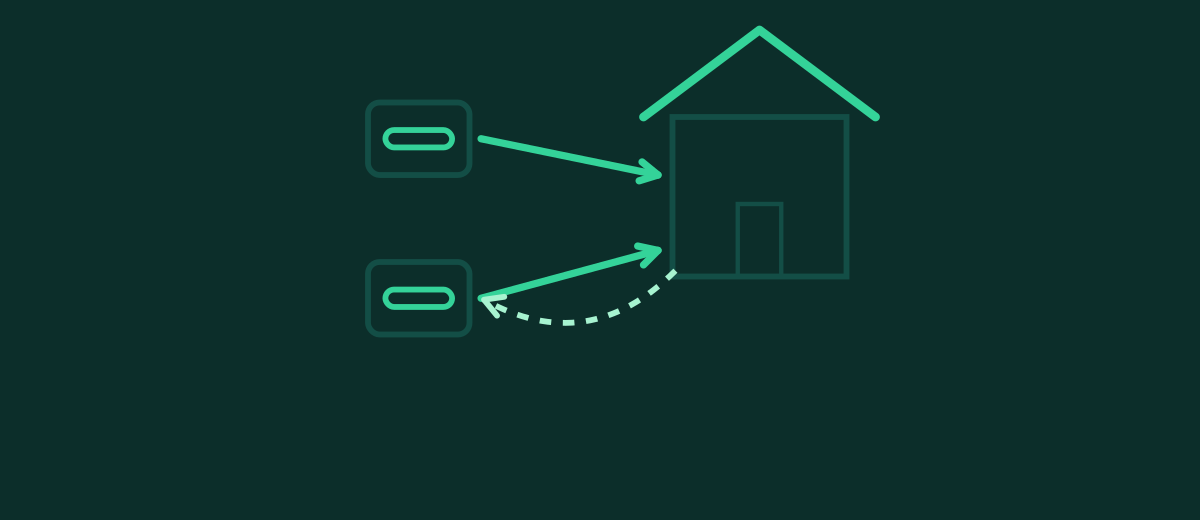
The FHSA and the RRSP Home Buyers’ Plan both let a first-time buyer pull down-payment money out of a registered account with no tax on the way out, and the difference is everything that happens afterward: an FHSA qualifying withdrawal is never taxed and never repaid, while a Home Buyers’ Plan withdrawal is a loan from your own RRSP with a 15-year repayment schedule attached. The two also stack, so one purchase can draw on both.
How the FHSA withdrawal works
The FHSA is the newer and cleaner of the two (what an FHSA is covers the account from the ground up). Contributions are deductible like an RRSP’s, growth is sheltered, and a qualifying withdrawal for a first home is tax-free like a TFSA’s, which makes it the one account that wins on both ends. Room accrues at $8,000 a year once the account is open, up to a lifetime $40,000, and unused room carries forward (to a maximum of $8,000), which is why the account rewards being opened early even with a token deposit. The room rules in full live in our FHSA contribution rules explainer.
At purchase time, the qualifying withdrawal can take out everything the account holds, contributions and growth alike, with no withholding, no income inclusion, and no repayment schedule, ever. The account then winds down: it must be closed by the end of the year following the first qualifying withdrawal. Where the balance sits while it waits is its own decision, and the FHSA board shows what issuers currently pay on FHSA GICs and savings.
The Home Buyers’ Plan is a loan, not a gift
The HBP is older and easier to misread. It looks like a tax-free withdrawal; it is actually an interest-free loan from your own RRSP. A qualifying first-time buyer can take up to $60,000 out with no withholding and no income inclusion, and must then pay it back into an RRSP over 15 years, with repayments starting the fifth year after the year of the withdrawal for first withdrawals made from 2022 through 2028 (the permanent rule is the second year; Ottawa has twice extended a temporary five-year grace period, most recently in the Spring Economic Update 2026, so a 2026 withdrawal’s first repayment is due for 2031). Each missed repayment converts that year’s scheduled slice into taxable income, so skipping is permitted but never free. The remaining schedule simply carries on, and nothing else is triggered; the skipped slice is permanently converted from restored retirement savings into a taxed withdrawal.
Repayments do not create new deductions (the money was deducted when it was first contributed) and do not consume new contribution room. You are restoring your retirement account on a schedule, nothing more.
One trap deserves its own paragraph: the 90-day holding rule. RRSP contributions made in the 90 days before an HBP withdrawal can lose their deductibility if they come straight back out, so a last-minute top-up intended for the down payment needs to land in the RRSP roughly three months before the money leaves it. Buyers working backward from a closing date should put this on the calendar first.
Side by side, then stacked
| FHSA qualifying withdrawal | Home Buyers’ Plan | |
|---|---|---|
| Source of funds | Your FHSA | Your RRSP |
| Tax on the way out | None | None (up to the cap) |
| Repayment | None, ever | Scheduled over 15 years |
| Cap on the withdrawal | The whole account balance | $60,000 |
| Contribution timing rule | None | 90-day holding rule |
| If a repayment is missed | (no repayments exist) | That year’s slice becomes taxable income |
And they stack. The programs are separate doors into the same purchase: a buyer who qualifies for both can make a full FHSA qualifying withdrawal and a full HBP withdrawal for the same home, each under its own conditions. For someone who has been filling both accounts for a few years, that stack can reach the full $40,000 of FHSA contributions plus the growth on them, on top of up to $60,000 through the HBP.
Which account gets the next dollar
When there isn’t enough cash flow to fill both, the mechanics themselves suggest an order, and it’s worth keeping mechanics separate from advice. An FHSA dollar is deducted on the way in and tax-free on the way out, with no obligations afterward. An HBP dollar was also deducted on the way in and comes out tax-free, but then claims 15 years of scheduled repayments, each one taxable if missed. On pure mechanics, FHSA room is the scarcer and better-behaved resource, and it expires as a first-home tool once you own a home, while RRSP room keeps its retirement job either way and the HBP lever stays available on whatever the RRSP already holds.
The standard complications: an FHSA takes years to fill at $8,000 a year, so a purchase eighteen months out changes the math, and a buyer with a large existing RRSP already has most of the HBP lever built. This is exactly the fork where general logic ends and your actual numbers, ideally with someone qualified looking at them, take over.
Where the money waits as closing approaches
The last stretch before a purchase changes the money’s job description: growth stops mattering and availability takes over. Down-payment funds with a known exit date generally sit in terms that mature before closing, in cashable GICs, or in plain savings, because a non-redeemable GIC that matures after your closing date helps no one (the cashable-versus-non-redeemable mechanics are in our GIC guide). Short terms and savings options across issuers are on the GIC board and the RRSP board, and a rate alert will catch a better short-term rate between now and closing day without you refreshing anything.
Frequently asked questions
Can you use both the FHSA and the Home Buyers’ Plan for the same home?
Yes. The two programs stack on a single qualifying purchase: a full FHSA qualifying withdrawal and a full HBP withdrawal can fund the same down payment, provided you meet each program’s conditions separately.
Do you have to pay back an FHSA withdrawal?
No. A qualifying FHSA withdrawal is final: no tax or withholding, and no repayment schedule. That is the core difference from the Home Buyers’ Plan, which must be repaid to your RRSP over 15 years or taxed piece by piece as income.
What is the 90-day rule for the Home Buyers’ Plan?
RRSP contributions made within 90 days before an HBP withdrawal may not be deductible if the withdrawal pulls them back out. The practical reading: money destined for the down payment through the HBP should arrive in the RRSP at least three months before it leaves.