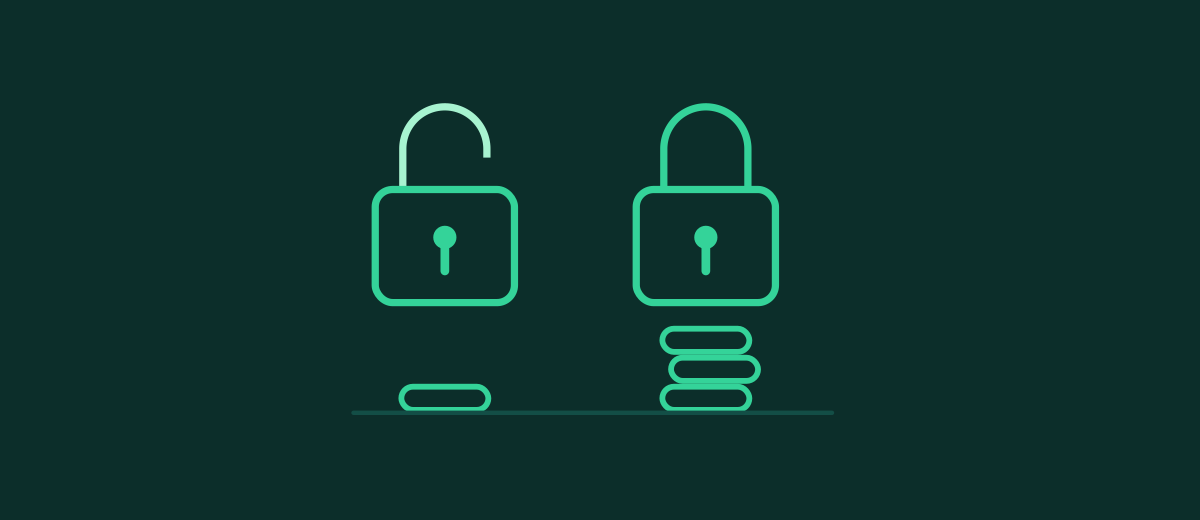
A non-redeemable GIC locks your money in until maturity and pays the highest rate in exchange for that commitment; cashable and redeemable GICs let you take your money back early, and you pay for that exit door with a lower rate. That’s the whole trade, and the rate simply tracks who gives up what.
The reason this deserves a full guide is that the labels aren’t standardized. One institution’s “redeemable” is another’s “cashable”, and the terms that actually matter (when you can redeem, and what interest you keep) live a few clicks deep in the product page. If GICs are new to you entirely, start with what a GIC is and come back; the fine print will still be here. The investor-education site GetSmarterAboutMoney.ca also keeps a plain overview of what a GIC is and how it works.
The three types, in plain language
- Non-redeemable: your deposit stays put until maturity. No early access in the normal course, and no exceptions you can plan around. In exchange, it earns the best rate an institution offers for that term.
- Cashable: after a short closed period (commonly 30 to 90 days), you can withdraw some or all of your money and keep the interest earned to that point. The rate is lower than a non-redeemable of the same term, and interest is usually forfeited entirely if you redeem during the closed period.
- Redeemable: you can exit at almost any time, but an early exit is paid at a reduced “early redemption rate”, which can be a fraction of the posted rate or nothing at all, sometimes on a sliding scale that improves the longer you stay.
Treat those as defaults, not definitions. Institutions use the words loosely, so the reliable move is to skip past the label and read the early-redemption terms themselves: when can you get out, and at what rate. Redeemability is also only one of the ways GICs vary; the full family of GIC types walks through the rest.
What locking in pays, and what leaving early costs
Banks pay a premium for money they can count on. A deposit that cannot leave for three years can be lent out for three years, so non-redeemable GICs consistently out-pay cashable ones of the same term. How wide that gap is depends on funding conditions and changes over time, which is why we won’t print a number here; the real answer sits on the current GIC boards, where flexible and locked-in offers can be compared for your term.
The cost of leaving early is where the fine print earns its reputation. Redeem a cashable GIC during its closed period and you typically get your principal back with no interest at all; redeem after the closed period and you generally keep interest at the full contract rate up to the day you withdraw. A redeemable GIC works differently: redeem it early and the early redemption rate applies to the entire time you held it, not just the remaining stretch, so if that rate is zero, months of waiting earn nothing. And a non-redeemable GIC mostly refuses the question — ask to break one and the usual answer is no, though some issuers make exceptions for death or demonstrated hardship, at their discretion, and usually with all interest forfeited.
One thing is never in question: your principal. At member institutions, deposit insurance protects the amount you put in regardless of which type you chose (how deposit insurance works); only the interest depends on your patience.
The live gap between the two sides sits in the table below: flip the switch and the price of the exit door is right there in the rates.
When flexibility is worth paying for
Flexibility is insurance, and the rate gap is the premium. Like any insurance, it makes sense when you might genuinely claim on it, and it’s a waste when you won’t.
It earns its keep when a known expense has an unknown date: a house closing, a tax bill that depends on an assessment, a tuition payment that lands whenever the paperwork clears. It also has a tactical use when rates are climbing, since a cashable GIC can be redeemed and re-bought at a better rate for the cost of a short wait.
It is the wrong tool for an emergency fund. Emergencies don’t wait out a closed period, and a high-interest savings account gives daily access with no redemption fine print at all. Our GIC vs HISA comparison weighs that choice in full. And flexibility is money left on the table when the funds genuinely won’t move before maturity, which is where non-redeemable GICs (and ladders built from them) do their best work.
| Your situation | A reasonable fit | Why |
|---|---|---|
| Money with a firm “do not touch” date | Non-redeemable | The lock-in premium is free money if you never use the exit |
| Might need it, timing unknown | Cashable | Access after the closed period, keeping interest earned to date |
| Emergency fund | High-interest savings account | Emergencies don’t wait 30 to 90 days |
| Expecting rates to rise soon | Cashable (or a short term) | Cheap to redeem and re-buy at a better rate |
| A small “maybe” fund beside a locked core | Split it (mostly non-redeemable, some cashable) | You pay the flexibility premium only on the slice that needs it |
Put a number on the exit door
The decision gets much easier with the actual gap in front of you. Suppose the cashable discount on your term were one percentage point (a figure invented for easy arithmetic) and you were placing $20,000: the exit door would cost about $200 a year, kept or wasted depending on whether you ever walk through it. Check the spread for your term on the GIC boards and decide what the flexibility is really worth to you. If the answer is “not much”, set a rate alert so the re-shop when the GIC matures takes care of itself.
Frequently asked questions
Can I get money out of a non-redeemable GIC in an emergency?
Usually not. Some institutions will break one for death or documented financial hardship, but it’s at their discretion and generally costs all accrued interest. Plan as though the answer is no, and keep emergency money somewhere with daily access.
What is the difference between cashable and redeemable GICs?
In common usage, a cashable GIC has a short closed period and then pays full interest to the date you withdraw, while a redeemable GIC can be exited earlier but pays a reduced early-redemption rate for the whole holding period. The catch is that institutions don’t use the labels consistently, so the redemption terms in the fine print outrank the name on the product.
Do I lose my interest if I cash out a GIC early?
Sometimes all of it, sometimes some. Cashing out during a cashable GIC’s closed period usually forfeits everything earned; after the closed period, you typically keep interest to date. Redeemable GICs pay their lower early-redemption rate instead of the posted one. Your principal comes back in every case.
Is a cashable GIC better than a savings account?
They solve different problems. A cashable GIC locks its rate for the term; a savings account rate can change any week, but the money is never more than a transfer away. Which one pays more shifts with the market, so compare the two boards rather than assuming.